Septic Tank Pumping
Routine and emergency pumping for residential and commercial tanks. 1,000-1,500 gallon standard.
Typical$300-$650
Routine pumping, emergency response, and full HSTS-permitted installs across Greater Cincinnati and Northern Kentucky since 2019, every job performed by an Ohio-registered septic contractor. Up-front fixed-price quotes, and written workmanship warranty.
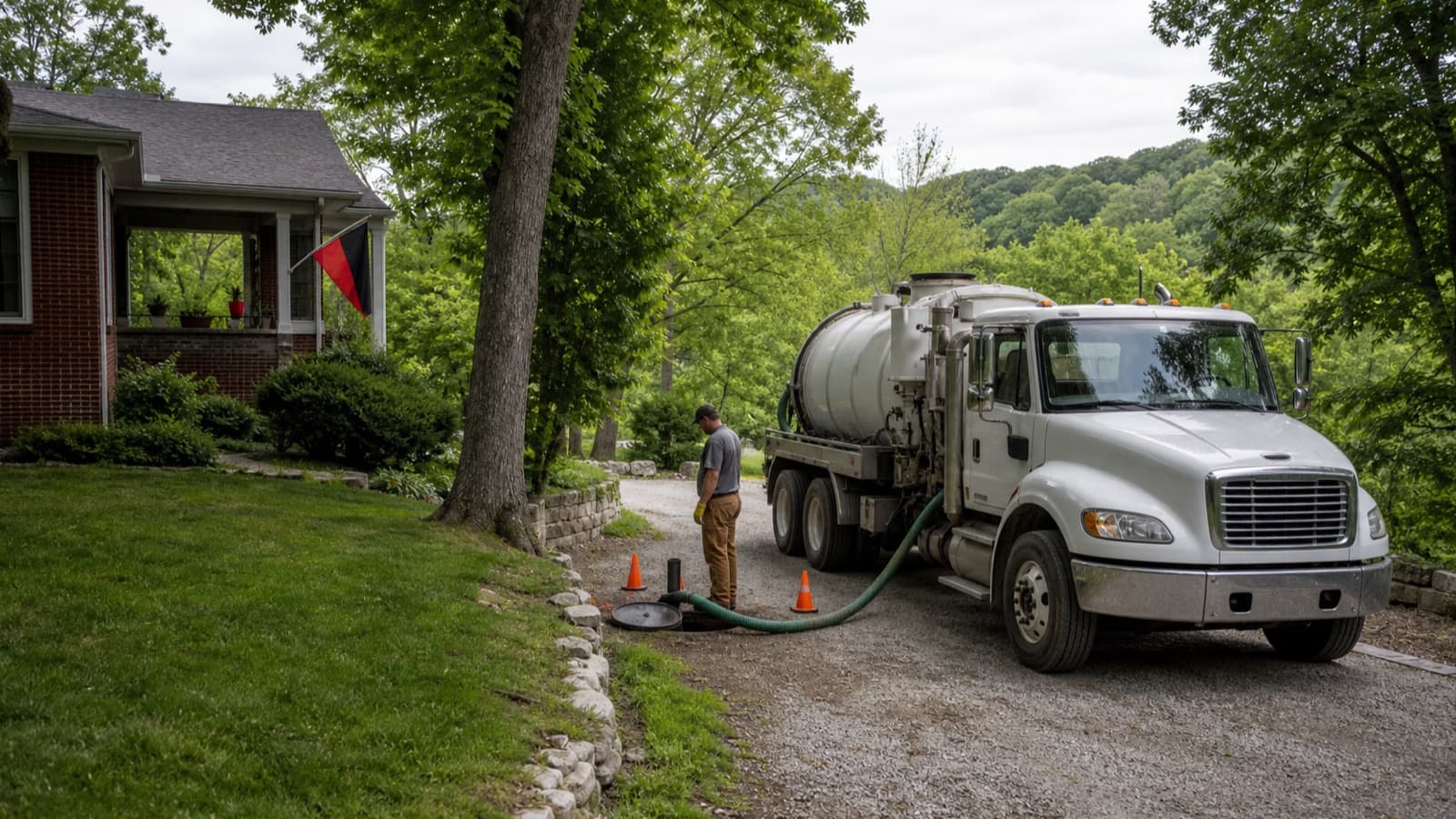
Step 1
Describe symptoms (backup, alarm, slow drains, odor) and we determine urgency. 10-min call, free.
Step 2
The contractor locates the tank (most in under 30 minutes), inspects baffles and effluent levels, and gives a fixed quote.
Step 3
Most pumping jobs complete in 1 hour. Repairs scheduled around weather; full installs around county permits.
Step 4
For repairs and installs the installer pulls Hamilton, Warren, Clermont, and Butler county permits, and we make sure you get closing-ready PDF documentation.
Recommended septic pumping frequency for a typical Cincinnati household with a 1,000-1,500 gallon tank.
Source: US EPA SepticSmart
Roughly 21 million US households use a septic system rather than municipal sewer.
Typical Cincinnati-area residential tank size. Hamilton and Warren county code minimums for newer installs.
EPA-recommended pumping schedules and inspection cadence for residential septic systems.
County health department oversight of septic permits and inspections in Hamilton County, OH.
Permit authority for septic installation and replacement in Warren County, OH.
State guidance on household sewage treatment systems (HSTS) and discharge rules.
Every job comes with a written quote and no-pressure consultation. Workmanship warranty terms are set by your lead technician and confirmed before work begins.
Routine and emergency pumping for residential and commercial tanks. 1,000-1,500 gallon standard.
Drain field repair, baffle replacement, distribution box, riser installation.
Conventional gravity, mound, drip, and aerobic systems. Permits handled.
Real-estate-grade inspections for buyers, sellers, and lenders.
Drain field rejuvenation, jetting, soil-fracturing, full replacement.
Same-day response for backups, alarms, and overflows. 7 days a week.
We are proud to offer $50 off any septic service for veterans, active military, first responders, and seniors 65 and older. Mention it when you call or submit your request.
Mention this offer when you call
(513) 838-3489“Tank had not been pumped in 11 years and the alarm finally went off on a Sunday night. They had a truck out by 9 AM Monday, pumped 1,250 gallons, cleaned the effluent filter, and added a riser so we never have to dig again. Fair pricing and clean work.”
“Drain field was failing and the county health department flagged us at re-permit time. They scoped a mound system, pulled the HSTS permit, did the install over four days, and walked the inspector through final commissioning. We are back in compliance with no surprises.”
“Old ATU air pump finally died after 18 years and the alarm panel was screaming. They diagnosed in 20 minutes, swapped the aerator the same afternoon, and adjusted the timer back to county-spec runtime. Cheaper than I expected for an emergency call.”
These reflect real situations from homeowners across our network. Names and some identifying details are adjusted to protect homeowner privacy while keeping the point of each story intact.

Hamilton County, Warren County, Clermont County, and Butler County each run separate Sewage Treatment System programs under the Ohio Department of Health, so the rules a homeowner in Loveland follows are not exactly the same as those a homeowner in Mason follows. Permits for new installs and major repairs run through the Hamilton County Public Health STS program, the Warren County Health District STS authority, the Clermont County Public Health, and Butler County General Health. Pumping does not require a permit; system replacement, drain-field replacement, and significant baffle work do.
Conventional gravity systems handle the majority of older exurban and rural Greater Cincinnati lots. The 1,000-1,500 gallon concrete tank size is standard for residential since the 1980s; older Hamilton County tanks (pre-1980) often run smaller and need upsizing during replacement. Aerobic treatment units (ATUs) are increasingly common where soil perc rates fail standard testing or where the lot drains toward a stream covered by Ohio EPA HSTS rules.
The single most important variable for system longevity is pump frequency. EPA's SepticSmart guidance is every 3-5 years for a typical 4-person household with a 1,000-gallon tank. Households with garbage disposals or above-average water use should drop to every 2-3 years. The math is simple: routine septic pumping in Cincinnati costs $300-$650; a failed drain field caused by skipped pumps costs $8,000-$15,000.
Ohio law requires the seller to disclose septic system type, age, and last-pump date on the Residential Property Disclosure Form. What it does not require is a transferable inspection, but most lenders (FHA, VA, USDA, conventional) ask for one within 90 days of closing. The minimum a buyer's lender wants to see: tank pumped to verify capacity and integrity, baffles inspected for collapse or root intrusion, drain field probed for saturation, distribution box checked for level, and sometimes a dye test where the field is suspected.
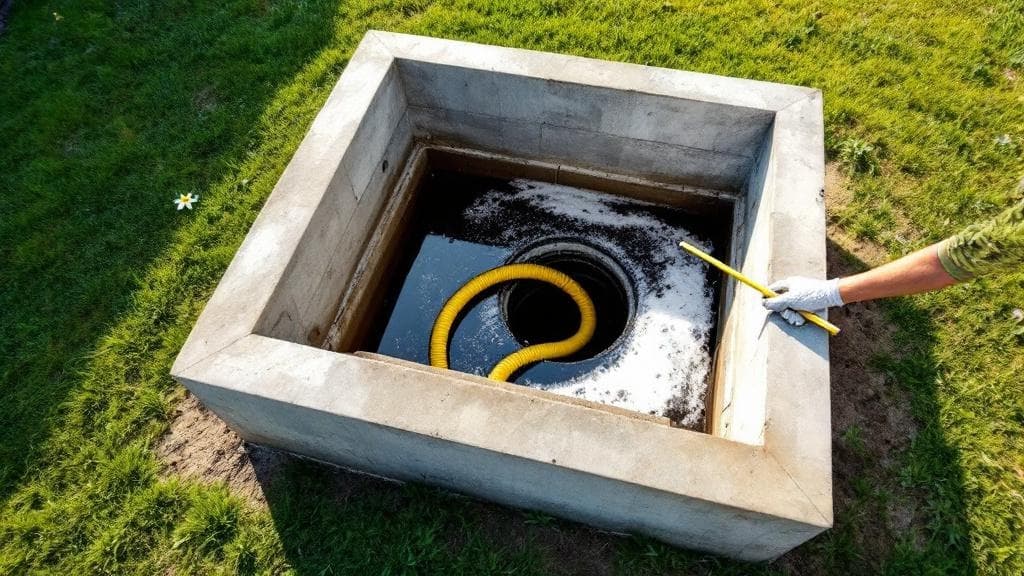
A real Greater Cincinnati septic inspection takes 90-120 minutes on site. A full septic inspection in Cincinnati is more thorough than a pump-only visit. The inspector arrives with a pump truck, locates the tank (most are within 30 minutes; some require county records and probe rods on overgrown lots), pumps it full, then runs water from inside the house for 20-30 minutes while watching the field for back-pressure or surfacing effluent. Anything irregular gets photographed and noted. The PDF report runs 4-8 pages including system schematic, baffle and lid condition photos, drain-field probe map, and a recommendation letter for the lender.
If the inspection finds a failed component (most commonly a collapsed inlet baffle, $400-$700 to replace, or a partially saturated drain field, $1,500-$15,000 depending on scope), the buyer's agent typically requests one of three things in writing: seller fixes before closing, seller credits the cost, or buyer walks. Sellers who pre-list-inspect and address findings before listing close 11-14 days faster on average than those who don't, per local Cincinnati MLS analysis.
A well-maintained Cincinnati septic system lasts 25-50 years. A neglected one fails in 10-15. The difference is six concrete practices.
Pump on schedule. EPA SepticSmart cadence is 3-5 years for a typical 1,000-gallon residential tank. Households with garbage disposals or above-average water use should pump every 2-3 years. Skipping cycles allows solids to escape into the drain field, where they accelerate biomat formation and shorten field life.
Use water efficiently. Modern low-flow fixtures (1.6 gpf toilets, 2.5 gpm showerheads, Energy Star dishwasher and washer) cut household water use 30-50% versus 1990s fixtures. The septic tank and drain field were sized for typical residential flow; reducing flow extends life proportionally. Replacing 1990s-era fixtures is one of the highest-ROI septic-protection moves.
Avoid the disposal-and-grease trap. Garbage disposals add 50% more solids; daily users should pump every 2 years. Grease (cooking oil, bacon fat, butter) solidifies in the tank and contributes disproportionately to scum-layer thickness. Compost food waste, scrape plates, and dispose of grease in trash, not down the drain.
Never flush wipes, paper towels, or hygiene products. "Flushable" wipes are not septic-flushable; they accumulate at baffles and require service calls to clear. Same applies to paper towels, feminine products, dental floss, cigarette butts, fabric softener sheets, and food scraps.
Protect the drain field. Keep heavy vehicles, parked cars, and structures off the field. Soil compaction destroys percolation. Divert downspouts and sump-pump discharges away from the field; stormwater overwhelm is a top-3 failure cause. Avoid deep-rooted trees within 25 feet (willow, maple, poplar, elm, sycamore are the worst offenders).
Maintain the effluent filter. Modern Ohio installs include one; older tanks can be retrofitted ($150-$250). Annual cleaning is a 5-minute job: lift, rinse with garden hose, drop back in. The filter catches solids that would otherwise migrate to the drain field, materially extending field life.
Following these six practices keeps a Cincinnati septic system in working order through normal demographic changes, multiple home sales, and decades of use.
Cincinnati homeowners weighing septic-versus-sewer often see the monthly sewer bill ($50-$100/month) and assume septic is cheaper. The 30-year math is more nuanced.
Sewer 30-year cost (4-person household): monthly sewer fee $50-$100 average = $18,000 to $36,000 over 30 years. Plus a one-time tap fee at connection ($1,500-$4,500). No tank, no field, no service interventions. Total: $19,500 to $40,500.
Septic 30-year cost (4-person household): routine pumping $300-$650 every 3-5 years = $1,800 to $6,500 over 30 years. Typical repair allowance for component replacement (effluent filter, baffle, distribution box, lift pump or aerator) $3,000 to $8,000. One drain-field replacement around year 20-30 if the original field reaches end of life: $8,000 to $15,000. Total: $12,800 to $29,500.
Net savings on septic over 30 years: $5,000 to $20,000, with the savings concentrated in households that maintain their system on schedule. Households that skip pump cycles and accelerate drain-field failure lose most or all of the savings.
Hidden costs not in the comparison: value of homeowner attention required for septic (modest, mostly remembering to pump). Value of resilience during power outages (conventional gravity septic works without power; sewer typically does too because municipal lift stations have backup, but lower-elevation neighborhoods can experience sewer backup during extended outages). Land-use flexibility (septic systems require maintained drain field area; sewer-connected lots can use the equivalent ground for landscaping, paving, or expansion).
When sewer connection makes financial sense: when the existing septic drain field is within 0-5 years of end of life and a county or HOA mandate is in effect (with grant subsidies typically available); when the homeowner plans to sell within 5-7 years and sewer connection meaningfully accelerates closing in their neighborhood. Otherwise, well-maintained septic remains the cheaper long-term option in Greater Cincinnati for the engaged homeowner.
Stage one is phone diagnosis. The Cincinnati-area dispatcher asks for symptoms (slow drains house-wide, gurgling toilets, sewage odor in the yard, lush patch of grass over the field, septic alarm going off, or a 3-year-marker reminder), property age, last known pump date, household size, and whether there is a garbage disposal. Five minutes of triage rules out non-septic plumbing problems and identifies whether this is a routine pump, an emergency, or a probable repair.
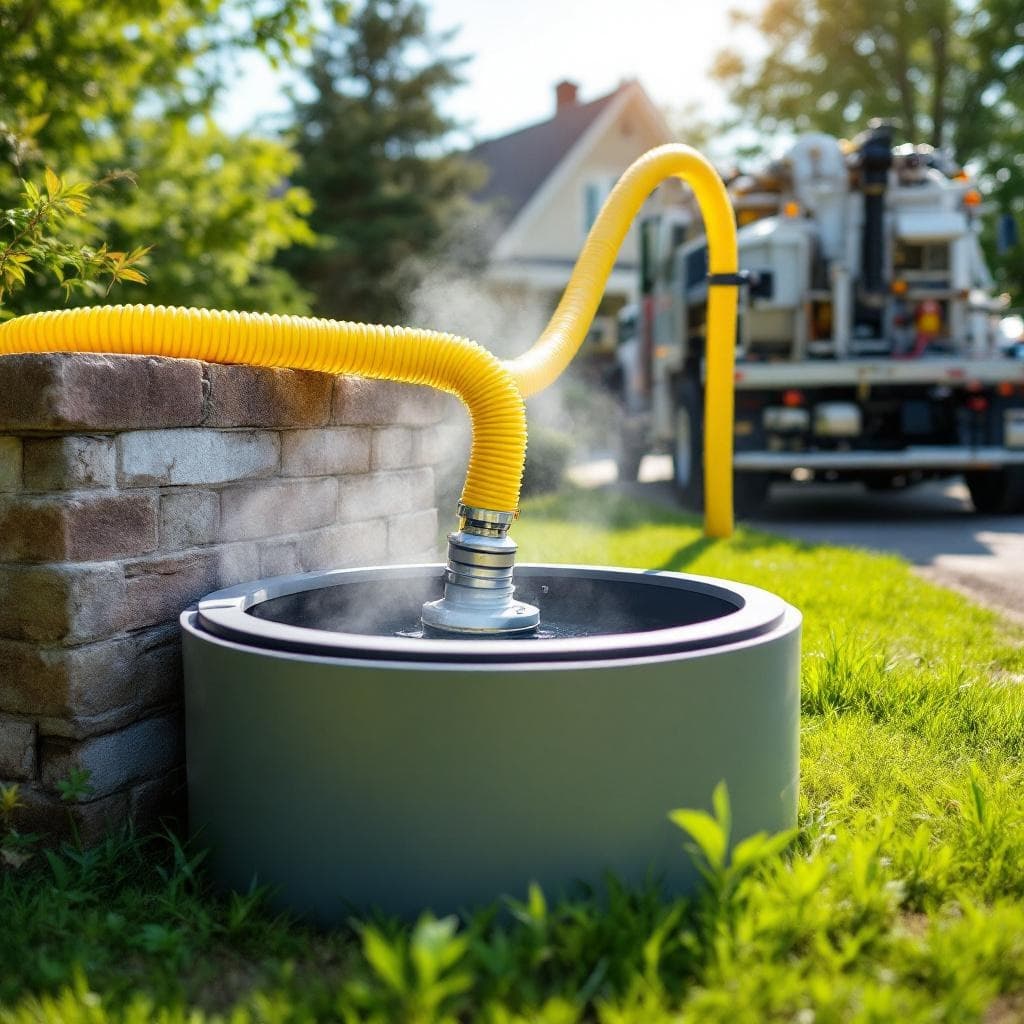
Stage two is the on-site visit. Local contractors locate the tank within 30 minutes using probe rods plus county GIS records. They open the inspection ports, measure the scum and sludge layers, photograph the baffle conditions, and pump the tank to depth. Most homes get a same-day fixed-price quote whether the work is just the pump or a follow-on repair scope. Cincinnati-area pumping runs $300-$650 for standard 1,000-1,500 gallon tanks; emergency same-day premium adds $150-$250.
Stage three is the work itself. A pump-only visit takes 60-90 minutes with the truck on site. Repairs (riser install, distribution-box re-leveling, partial drain-field rejuvenation) run a half day to two days. Full system replacement runs three to five days plus county permit time, which is one to four weeks depending on county. Hamilton County permits are typically faster than Warren County permits for residential.
Stage four is paperwork and warranty. Permitted work generates a county inspection sign-off that goes into the homeowner's file and, on real-estate transactions, into the lender package. Workmanship warranty terms are confirmed in writing before any work begins, and we make sure what was put in writing is honored. Warranty length and coverage vary; ask up front.
Greater Cincinnati and Northern Kentucky and surrounding communities. Same-day estimates within 25+ neighborhoods.
Most Greater Cincinnati and Northern Kentucky septic jobs get a fixed-price quote within the same business day. ORC 3718-registered installers coordinating with the Northern Kentucky Health District and the OH county health authorities.
Browse all 61 questions for more depth.
A standard 1,000-1,500 gallon septic tank pump in Greater Cincinnati runs $300-$650. Larger tanks, riser installs, and emergency same-day visits cost more. Pricing is given up front before any work begins.
Cincinnati pumping pricing breaks down by tank size, accessibility, and timing. Standard 1,000-gallon residential: $300-$425. 1,500-gallon residential: $400-$525. 2,000-gallon (large household or commercial): $500-$650. Add $150-$250 emergency premium for same-day or after-hours dispatch. Riser install (so future pumping does not require digging up the lid) is $200-$400 once and saves cumulative time forever. Effluent-filter retrofit is $150-$250. Inspection-only (without pumping) for a real-estate transaction or pre-purchase scope is $250-$400. Greater Cincinnati pricing has been stable across Hamilton, Butler, Warren, and Clermont counties for the past 3-4 years; quotes from credentialed pumpers rarely vary more than 10-15% on the same scope. Free phone consultations include tank-locating triage if the homeowner is uncertain about size or location. Cincinnati-area pricing transparency: the on-site quote breaks out the truck visit, the pump labor, the disposal fee, and any optional add-ons (riser install, effluent filter, baffle inspection) as separate line items. That makes it easy to compare quotes across providers. Watch for quotes that bundle everything into a single "service call" total without itemization; the bundled price often hides $100-$200 of margin that itemized quotes do not.
Most Cincinnati-area homes need pumping every 3-5 years. Households with garbage disposals or above-average water use should pump every 2-3 years. A household of 4 with a 1,000-gallon tank typically fits the 3-year mark.
Pump frequency is a function of tank size, household size, and water-use pattern. The EPA SepticSmart guidance is a 3-5 year cadence for typical 1,000-gallon residential, scaled by household. The cleanest math: total daily wastewater volume per person is roughly 50-70 gallons; a household of 4 produces 200-280 gallons per day, which fills the tank to working capacity in roughly 12-18 months and reaches full-pump-required level in 3-4 years. Garbage disposals add roughly 50% more solids and shift the cadence to every 2-3 years. Above-average water use (frequent guests, large laundry loads, soaking tubs) similarly accelerates. The cost of skipping a pump cycle: a saturated drain field replacement runs $8,000-$15,000 versus a $300-$650 pump. The 3-5 year recommendation is intentionally conservative because the economic asymmetry is so large. Cincinnati cost-of-skip math: a $400 pumping cost amortized to annual cadence is roughly $80-$130 per year. The cost of a failed drain field caused by skipped pumping is $8,000-$15,000, equivalent to 60-200 years of pumping at the recommended cadence. The asymmetry is so large that the EPA SepticSmart 3-5 year cadence is conservative; staying ahead of it (3-year pump in households with disposals or above-average use) is standard practice for owners who plan to keep the home long-term.
Slow drains throughout the house, gurgling toilets, sewage smell in the yard, lush green grass over the drain field, sewage backups in the lowest drain, or septic alarm activation. Any of these warrants same-week service.
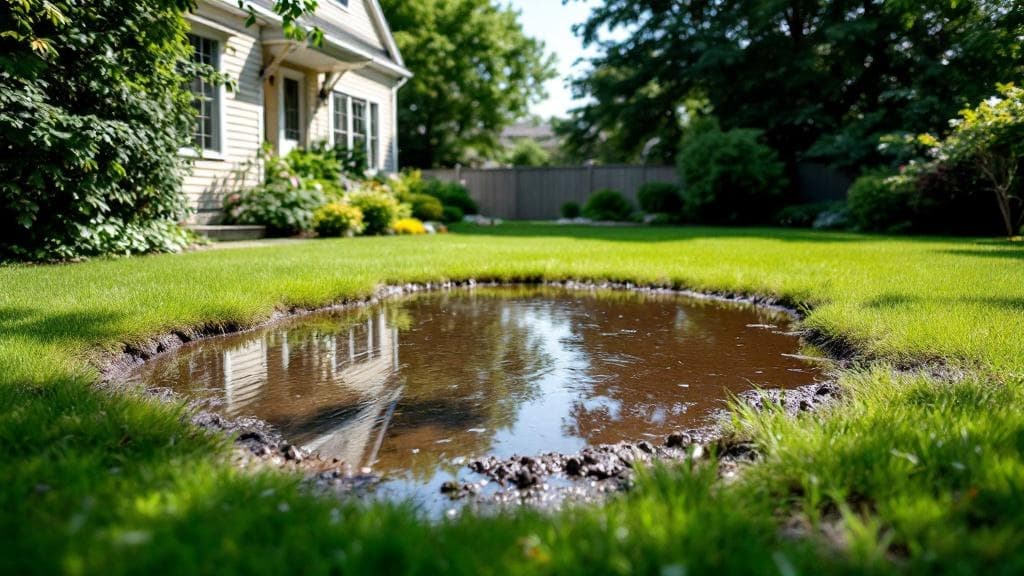
Symptoms cluster into two categories: tank-side and drain-field-side. Tank-side symptoms (slow drains, gurgling toilets, basement floor-drain backup) usually trace to a full or near-full tank, a collapsed inlet/outlet baffle, or an effluent-filter blockage. These are typically inexpensive to fix ($300-$700) if caught early. Drain-field-side symptoms (sewage smell in the yard, lush green patches over the field, surfacing effluent, septic alarm in aerobic systems) usually trace to drain-field saturation, biomat overgrowth, or root intrusion. These are more expensive ($1,500-$15,000 for rejuvenation or replacement). The window between "first warning sign" and "raw sewage on the basement floor" is typically 6-24 hours for tank-side symptoms and 1-4 weeks for drain-field-side symptoms. Same-week service for any of these symptoms catches problems before they become emergencies. Cincinnati emergency-vs-routine triage: gurgling drains plus a single slow drain typically indicates a tank-side issue (full or near-full tank, baffle problem) and warrants same-week service but not emergency dispatch. Active sewage backup, multi-fixture slow drains, or sewage smell in the yard indicates a more urgent situation and warrants same-day dispatch. Septic alarms (on aerobic systems) are the most urgent indicator and warrant immediate calling.
Same-day across Greater Cincinnati for active backups, alarms, or overflows. Most emergencies handled within 4 hours of the call during business hours; 24/7 emergency line for after-hours.
Septic emergency dispatch in Greater Cincinnati typically arrives within 2-4 hours of the call during normal business hours and within 4-8 hours after-hours. The on-site response sequence: confirm symptoms (active backup, alarm, or overflow), locate the tank lid, pump down to safe levels to stop the active overflow, identify the root cause (full tank vs baffle failure vs drain-field saturation vs blockage), and either complete the fix on site or stabilize and schedule the full repair. Holiday-weekend emergencies cost an additional $200-$400 premium on top of standard pumping rates because the install teams are paying overtime. Most homeowners can wait until next-business-day if symptoms are mild (slow drains only, no active backup); active backup or sewage in the home requires same-day response to prevent water damage and biohazard risk. Cincinnati holiday and weekend dispatch: most local install teams maintain a rotating after-hours emergency line through Hamilton, Warren, Clermont, and Butler counties. Holiday-weekend response can run 2-4 hours longer than business-day response and carries an additional $200-$400 premium. For a homeowner facing a non-active backup (slow drains warning of an upcoming problem), the cheaper move is to wait until next business day and pay standard rates.
Yes. Tank location uses probe rods, septic-locator equipment, and county records. Most buried tanks are found within 30 minutes. Once located, the technician typically installs a riser so future access takes seconds, not hours.
Tank location starts with county records (Hamilton County Public Health, Warren County Health District, etc. all maintain installation diagrams for permitted systems back to roughly 1980). For older systems without records, the technician uses a combination of: (1) probe rods to feel for the lid, (2) electronic septic locators that detect ferrous metal in tank lids, (3) flushing a transmitter dye through the toilet and tracking it with a receiver. 90% of Greater Cincinnati tanks are found within 30 minutes; the remaining 10% require more invasive search (small hand-excavation in suspected zones). Once located, the technician typically recommends a riser install ($200-$400) so future pumping or inspection visits do not require any digging. Risers are cosmetically discreet (green plastic lid flush with grade) and dramatically reduce labor cost on every subsequent visit. Cincinnati older-home tank-locating challenges: pre-1980 systems in unincorporated Hamilton County and rural Warren County sometimes lack any county records. Cincinnati technicians use a combination of probe rods, septic-locator equipment, and dye-tracing through the toilet plumbing to locate buried tanks. 90% are found within 30 minutes; the remaining 10% may require 1-2 hours of search and modest excavation. Once located, riser install (a one-time $200-$400 cost) makes every future visit fast and dig-free.
Routine pumping does not require a permit. New installations, drain-field replacement, and significant repairs require a permit from your county health department. The registered installer on your job handles the permit process in Hamilton, Warren, Clermont, and Butler counties.
Ohio Department of Health delegates Sewage Treatment System (STS) permit authority to county health departments. Permit-required work includes: a new septic installation in Cincinnati, full system replacement, drain-field replacement or expansion, distribution-box relocation, ATU (aerobic treatment unit) installation or major service, and any work that changes the system's discharge point. Permit-exempt work includes: routine pumping, riser installation, effluent-filter installation, baffle replacement (typically), minor cleanout repair. Each county has its own permit fee schedule and timeline. Hamilton County permits are typically faster than Warren County for residential. Permit issuance runs 1-4 weeks depending on county and season. Local contractors hold the appropriate Ohio STS installer credentials and pull permits on behalf of the homeowner; the cost is line-itemed in the quote rather than charged separately. Cincinnati county-by-county permit speed: Hamilton County typically issues permits in 1-2 weeks for residential repair work. Warren County runs 2-4 weeks. Clermont County is in between. Butler County varies seasonally. Local contractors flag the expected permit timeline at quote time so the homeowner can plan around it. Emergency repairs (active backup, septic alarm) sometimes get expedited issuance under "imminent health hazard" provisions.
Check your water bill. If there’s no sewer charge, you’re on septic. Or check the property: if you have a green/cap-style access lid in the yard, that’s a septic tank. Most rural Cincinnati and exurban properties are septic.
Three quick ways to confirm. (1) Water-and-sewer bill: municipal sewer customers pay a monthly sewer charge typically equal to or greater than the water charge; septic customers pay water only. The bill line item will say "Sewer Service" or similar. (2) Yard inspection: a green or black plastic riser lid (10-24 inch diameter) flush with grade indicates a septic tank below; a metal grate or concrete cleanout cap indicates municipal sewer. (3) County records: each county health department maintains records of permitted septic installations searchable by address. Roughly 60% of Greater Cincinnati housing on city water is also on city sewer; the remaining 40% (mostly older exurban single-family) is on septic. Most homes built after 1990 in unincorporated Hamilton County, rural Warren County, and Clermont County are on septic; municipal sewer expansion has been gradual but slow. Cincinnati conversion-grant tracking: Hamilton County Public Health, Warren County Health District, and Butler County General Health periodically run sewer-conversion grant programs that subsidize the connection cost for properties within 200 feet of an existing main. Programs come and go; check the relevant county health department website annually if conversion is on the table. The grant typically covers 25-60% of total project cost.
Not always. Many failing drain fields can be rejuvenated through soil fracturing, jetting, or partial-line replacement at 20-40% of full-replacement cost. Local contractors inspect first, recommend the least-invasive fix.
Drain-field rejuvenation techniques include high-pressure jetting (clears biomat and partial root intrusion in distribution lines, $400-$1,200), soil fracturing (uses high-pressure air to break up compacted soil and biomat in the absorption field, $1,200-$3,000), partial-line replacement (replaces failed sections of the absorption field, $2,000-$6,000), and full replacement (entire drain field replaced, $8,000-$15,000+ depending on county code requirements). The right choice depends on the diagnostic findings: jetting works for early-stage biomat without saturation; fracturing works when the field is structurally intact but compacted; partial replacement works when failure is localized to specific lines; full replacement is required when the entire field is saturated or structurally failed. Local contractors run a thorough on-site diagnostic (probe rods at multiple points across the field, dye tracing, distribution-box inspection) before recommending a strategy. Avoid contractors who quote full replacement without a diagnostic; that is often a flag. Cincinnati drain-field rejuvenation note: jetting and soil-fracturing techniques work best on fields that are showing early-stage failure (occasional surface saturation under heavy water use, no surfacing during normal use). For fields that are consistently surfacing or failing perc tests, partial-line replacement or full replacement is typically required. Local contractors run a thorough on-site diagnostic before recommending the appropriate technique.
Routine pumping, emergency response, and full HSTS-permitted installs across Greater Cincinnati and Northern Kentucky since 2019, every job performed by an Ohio-registered septic contractor. Mon-Sat 7am-7pm · Emergency 24/7.